If you are joining my session at FLEX, bring a hybrid facilitation problem that has stayed with you.
Perhaps the people in the room talk easily while the online participants wait. Perhaps an activity creates energy, but the useful observations disappear before the debrief. Or perhaps the shared board looks full while the group is still unclear about what it has learned.
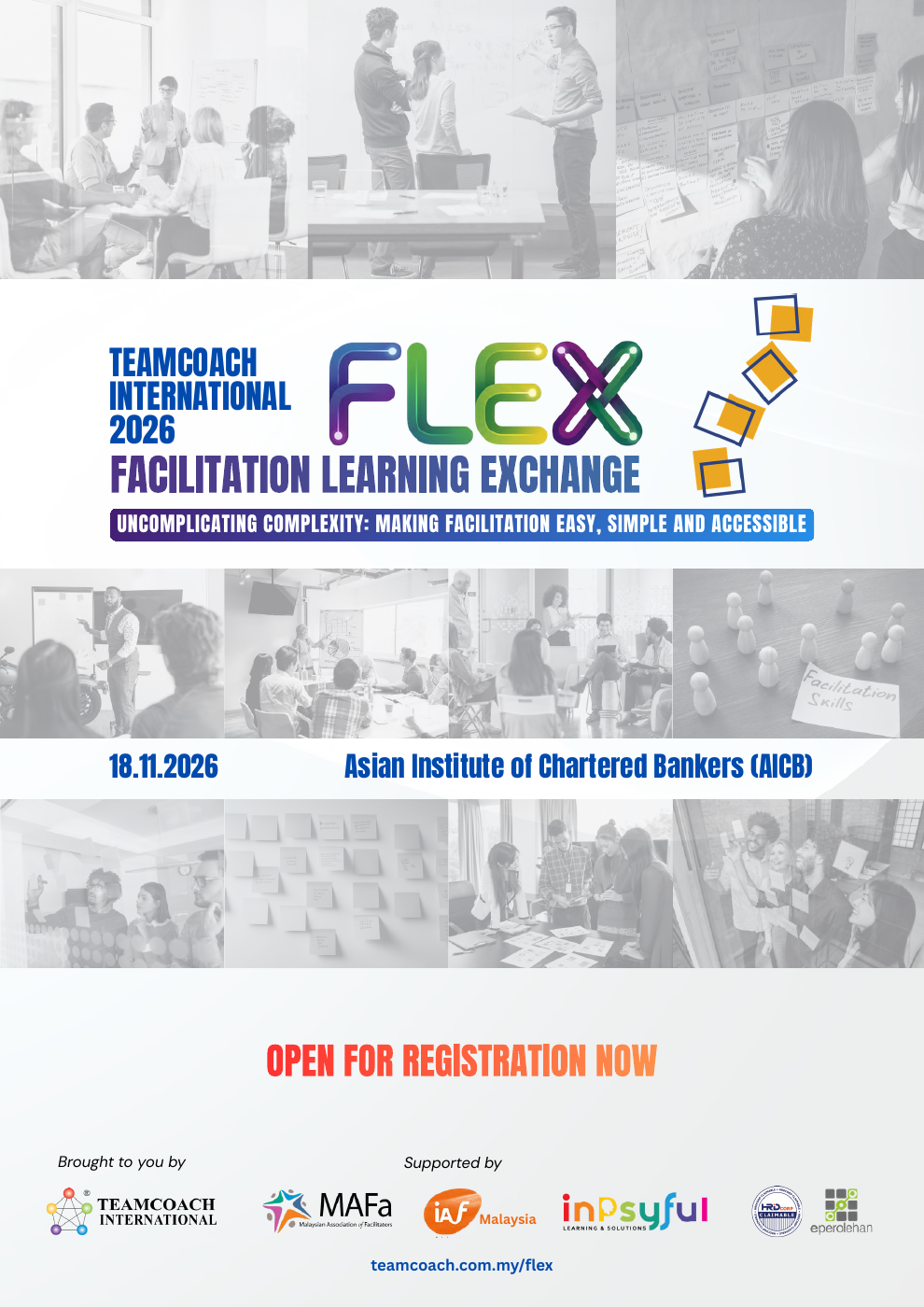
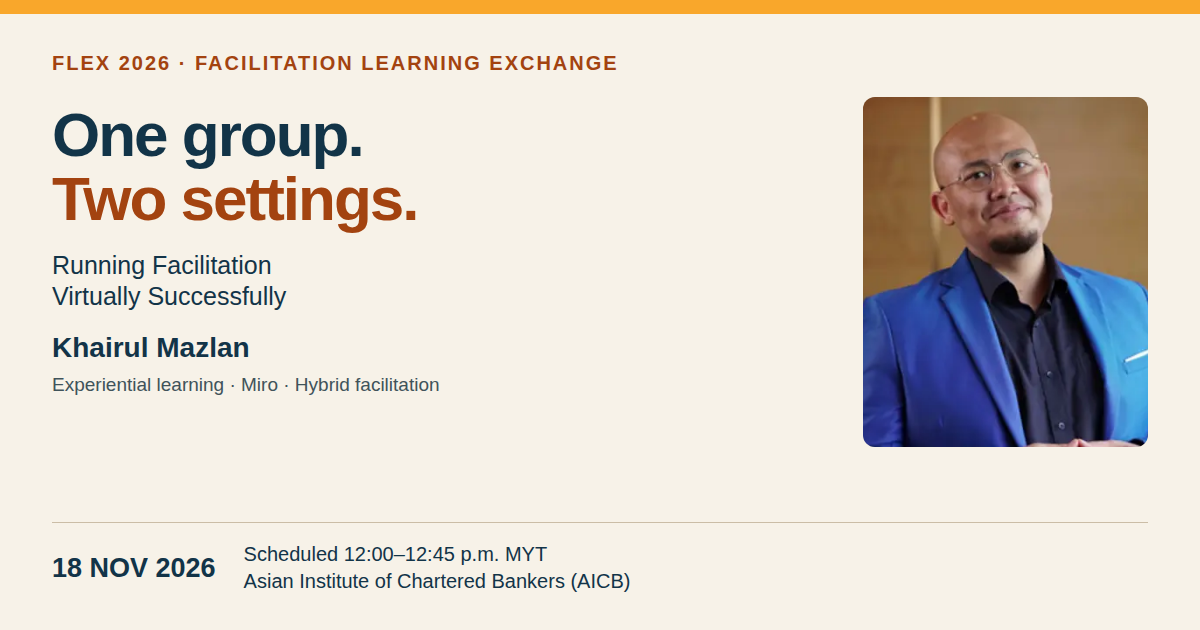
These are the questions I’m preparing to explore in “Running Facilitation Virtually Successfully” at FLEX 2026: Facilitation Learning Exchange, on 18 November 2026 at the Asian Institute of Chartered Bankers (AICB). My session is scheduled for 12:00–12:45 p.m. Malaysia time, subject to programme changes.
The programme describes my session as exploring digital tools and AI for engagement. My planned emphasis within that is practical: experiential learning, using Miro to collect insights, and helping a facilitator work with people online and in the room simultaneously. If that resembles your next assignment, keep the midday session in your plan. I want it to help you look at the decisions that make participation possible across both settings.
I want to begin with something people can experience
What interests me is how we create an experience that gives people something worth reflecting on.
An activity might reveal how a group handles incomplete information, checks an assumption or decides who takes the next step. The debrief then helps participants examine what happened and connect it to a situation they recognise at work.
For me, the facilitator’s work includes both parts: designing the experience and helping the group make sense of it. A lively activity without that second part can leave people with a memorable moment and little clarity about what to do differently.
At FLEX, I’m planning to bring that experiential perspective into the conversation about virtual and hybrid facilitation. The platform should support the learning task, and the task should give the group a reason to use the platform.
I want Miro to help us see the thinking
A shared board can hold more than a collection of suggestions. I’m interested in using Miro to help distinguish observations, interpretations, questions and next steps.
Consider an illustrative coordination exercise. After the task, I might ask people to record what they noticed before we discuss why it happened. That makes room for several accounts of the same experience. We can then examine the assumptions behind them and agree a small change to test.
That is a design example, rather than a fixed exercise promised for the conference. The point is to make insight collection serve the discussion: what needs to be visible for the group to think more clearly?
Miro’s workshop guidance offers tools for preparing collaborative work. I still need to decide the question, participation sequence and debrief. A board cannot make those decisions for me.
I’m designing for the person who is easiest to overlook
When some people are in the room and others join online, the room has advantages. People can catch a gesture, exchange a quick comment or speak before someone online finds an opening.
I want to examine the facilitation choices that help the whole group stay in the conversation:
- One set of instructions people in both settings can access.
- A deliberate route for online contributions, alongside those from the room.
- Someone responsible for noticing online questions and difficulties.
- A shared record that contributors can check and correct.
- A simple alternative for anyone unable to use the board.
Sometimes a participant’s best route is to speak while someone records their point and reads it back. Sometimes a co-facilitator is needed to support the online group. The right arrangement depends on the task, group and resources available.
I would also test the sound. If someone cannot hear the discussion, access to Miro will not make the experience workable. Technical preparation is part of making participation possible.
The access test belongs before the session
I would not judge readiness only by what works on my own screen. I need to test the route a participant will actually use, including whether they can open and contribute to the board.
Miro’s visitor documentation makes clear that access depends on the board settings and plan. A public board link can also travel beyond the intended group. I would use non-sensitive practice material and agree how contributions are attributed, shared and retained before working with real organisational information.
I also want a fallback that people understand: a short spoken contribution, a message, or a person assigned to capture input. That keeps a tool difficulty from becoming a reason someone’s thinking disappears.
Bring a challenge you want to work through
I’m not asking you to arrive with the perfect hybrid setup. Bring the moment you find difficult: the quiet online group, the rushed debrief, or the gap between the activity and the action people take away.
My starting question is: how can the experience, the conversation and the shared record work together for the whole group? That is what I want this session to make practical.
It connects with my earlier writing about workshops that lead to decisions and actions. Whether the group meets in one room or across locations, the record matters when people can use it to understand and act on what they have agreed.
I’ll be part of a wider learning exchange
Teamcoach International has brought together a programme around “Uncomplicating Complexity: Making Facilitation Easy, Simple and Accessible,” supported by the Malaysian Association of Facilitators (MAFa), IAF Malaysia and Inpsyful Learning & Solutions. I’ll be joining:
- Ho Sze Chieng, Opening Keynote.
- Marziana Mohd Zain, Enabling Leaders to Listen.
- Daniel Gonzaga, Beyond the Generational Divide: One Workplace, Many Worlds.
- Lt Col Christopher Ignetius Choong (Rtd), When We Disagree: Making Complexity Easier to Work With.
- Amy Wan Ratos, Actions and Implementation.
- Bravo Looi, Uncomplicating Complexity with W3 (What, So What, Now What?).
- Bavani Periasamy, Designing the Thinking of the Room: Moments That Matter.
- Capt. Dr. Shan Moorthi, Closing Keynote.
I see a useful connection across that day: listening to people, working with different perspectives, making thinking visible and helping a group move towards action. My session brings the challenge of doing that across online and in-room participation into the exchange.
Join me at FLEX
FLEX takes place on Wednesday, 18 November 2026, at AICB in Kuala Lumpur. My session is scheduled for 12:00–12:45 p.m. Malaysia time. Please check the current programme, as times and speakers may change.
You can find the programme and registration options on Teamcoach International’s official FLEX page. Confirm current fees, HRD Corp claim arrangements and any ePerolehan requirements with the organiser; the October early-bird deadlines have passed.
I’m discussing hybrid facilitation as a practice. FLEX is listed as an event at AICB, so check with Teamcoach about attendance arrangements rather than assuming you can join remotely.