If your people return from training with new skills, what needs to happen in their team for those skills to become useful?
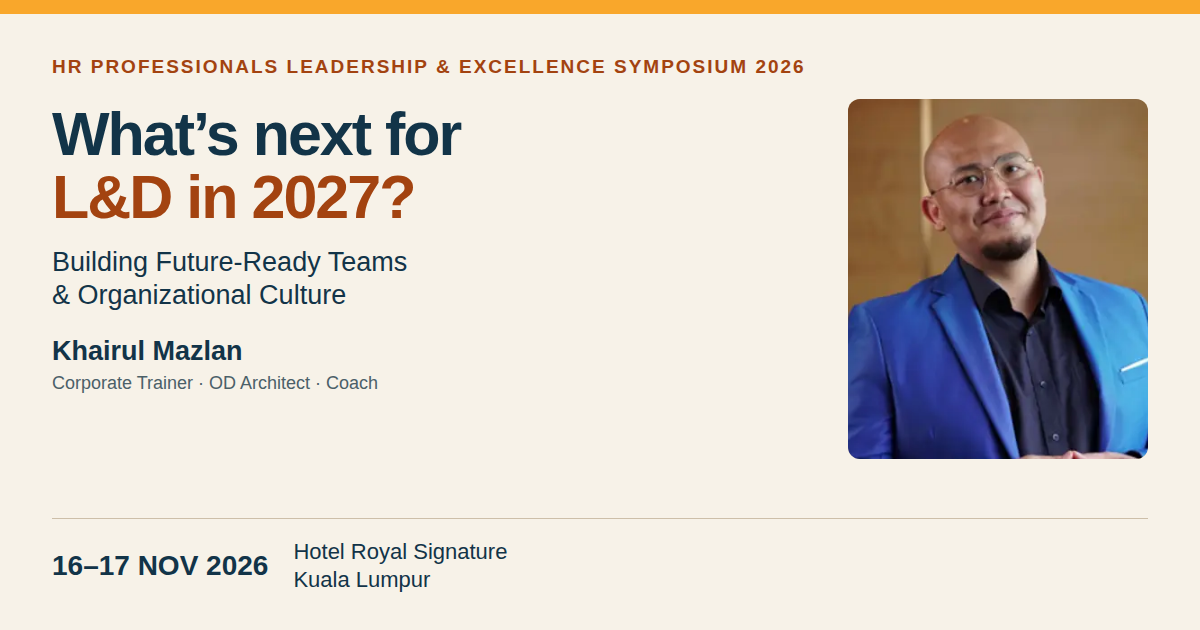
That is the question I want to bring to the HR Professionals Leadership & Excellence Symposium 2026, on 16–17 November at Hotel Royal Signature Kuala Lumpur. My session is “What’s Next for L&D in 2027? Building Future-Ready Teams & Organizational Culture.”
I will be looking at the relationship between individual development, team dynamics and the culture people experience at work. For me, future readiness includes the ability to raise a concern, work through disagreement and turn a decision into coordinated action.
Training investment deserves a workplace question
HRD Corp’s 13 January 2026 announcement reported RM2.62 billion in approved financial assistance for training and skills development in 2025. Approved funding tells us about the scale of support. It does not tell us how much was disbursed or what changed in every participating workplace.
I see that scale as a reason to ask better questions about what happens after learning. Can someone use a new skill if their team has conflicting priorities? Can a manager coach effectively if every conversation is overtaken by unresolved ownership or workload problems?
Training hours remain useful records. I want the 2027 conversation to go further: what are people now able to do together, and where is the evidence?
I want to separate building a team from booking teambuilding
There is room for connection, energy and enjoyment in a team programme. I do not want to remove the fun. I want the activity to have a purpose the team can recognise when they return to work.
Building a team involves agreements about priorities, roles, decisions and how people handle differences. Booking a teambuilding event does not automatically create those agreements.
Consider this illustrative situation: two departments leave a workshop feeling positive, but the next customer handover still has no clear owner. The shared experience may have been valuable. The handover problem still needs a specific agreement and someone with the authority to support it.
In my session, I will explore how HR can connect an engaging intervention to the team’s actual work instead of asking the event to carry an undefined promise of transformation.
The blind spot may be in the relationship between roles
Before choosing an activity, I would ask the team to bring a recent example of work that became difficult between people or functions.
Where did an assumption go unchecked? Who believed someone else owned the decision? Which concern was raised only after the meeting had ended?
I want to examine those questions without assuming that every difficulty is a motivation problem. Sometimes people need practice. Sometimes the team needs a clearer routine. Sometimes the organisation needs to change authority, workload or a process before another course will help.
That distinction matters to the design of the intervention and to what HR can reasonably expect it to achieve.
Psychological safety needs a response after someone speaks
One of the session’s focus areas is the connection between psychological safety and the conditions that help people stay and contribute.
Amy Edmondson’s original team-learning research found that psychological safety was associated with learning behaviour. I take that as a reason to examine how teams handle questions, mistakes and disagreement. I do not take it as proof that one workshop prevents resignations.
I want to ask what happens after a person speaks up. Does the manager explore the concern? Is a different view considered? Can the team tell the difference between a mistake to learn from and conduct that requires accountability?
A facilitated session can help people practise those conversations. What leaders do afterwards helps determine whether that practice becomes part of everyday work. Retention also depends on other conditions, including reward, workload and career opportunities.
Measuring true ROI starts with a clear evidence chain
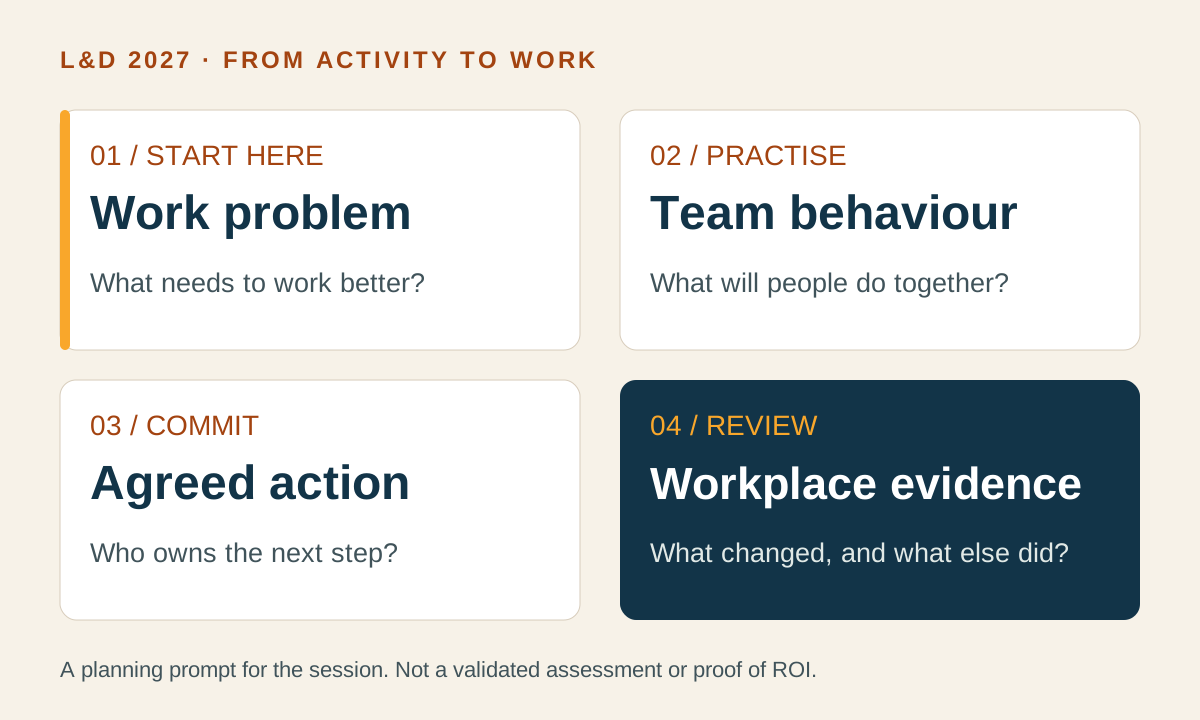
My starting point is a simple planning prompt:
Work problem → team behaviour → agreed action → workplace evidence.
For an illustrative handover problem, that could mean practising a clearer commitment check, agreeing an exception owner and reviewing incomplete handovers over a defined period. Before delivery, HR and the sponsor should agree the baseline, who owns the follow-up and what will be recorded.
Positive feedback is worth hearing. It is different from evidence that the work improved. A financial ROI claim needs credible attributable benefits and full costs; a change in results alone does not establish that the programme caused it.
I would rather see a team report one observable improvement honestly than attach a dramatic percentage to evidence that cannot support it. My earlier article on workshops that end with decisions and actions explains the follow-through question in more detail.
Bring a team question to the symposium
I will be exploring six connected areas: the difference between building teams and teambuilding; culture gaps and team dynamics; intervention design; psychological safety and retention; practical alignment; and how to evaluate team development responsibly.
If you are attending, bring one recurring team problem you want to understand better. A real question about a handover, meeting or decision will make this conversation more useful than another broad request to “improve teamwork”.
The HR Professionals Leadership & Excellence Symposium 2026 takes place on 16–17 November 2026 at Hotel Royal Signature Kuala Lumpur. It is organised by Training Valley. For the programme, my session time, fees and registration, contact aidid@trainingvalley.com.my or nabila@trainingvalley.com.my, or WhatsApp +6012-829 6393 / +6012-967 6393.
I look forward to discussing what we want our teams to be able to do together in 2027.